

When to close position is a question of great concern to many traders.
Yet there is no standard answer, as different traders approach the market with different trading strategies. However, there are indeed generally accepted timings in the market. Today, let's get to know a few great profit-taking times recognized by many traders.
1. Supports and resistances: close position at key levels
When you are trading you often try to hold on to trades in the hope that they will break through key support and resistance levels. This is a common trap for traders. In reality, unless there is some extremely significant news, most daily support and resistance levels hold on the first test. As a result, you may close position when your trades go into those levels.
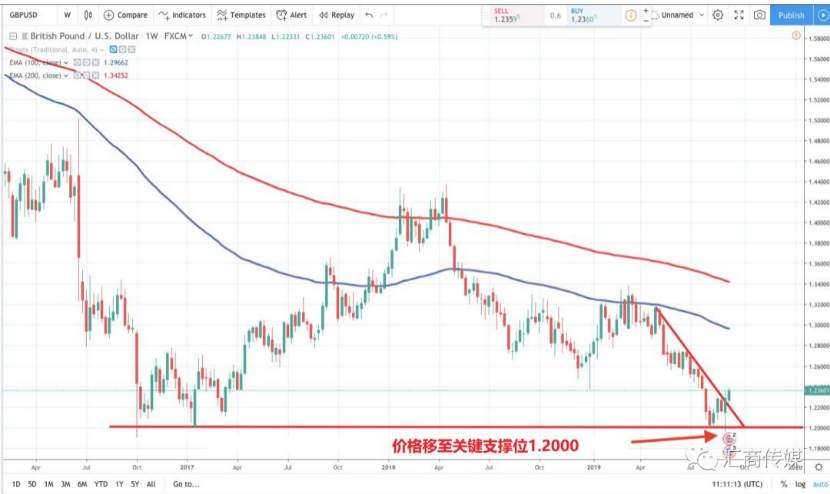
Here is a simple example. The GBP/USD pair has been sold heavily on Brexit concerns. The GBP fell down into the key daily support level of 1.2000, and it seems there is little to indicate that the GBP should be bought. This 1.2000 level was the ideal place to close position. When falling into 1.2000, traders may try to hold for the break of that level. Savvy traders, however, booked their profits here, and then waited for a 'fresh catalyst to get short'. This is the most common timing: close position at key support and resistance levels.
2. close position at 40-60% of the Average True Range (ATR) for intraday trades
For day traders, although there are times to hold your intraday trades, the general rule of thumb is take intraday profits at around 40-60% of the average true range (ATR). You can plot the ATR on your chart. This is usually around 25-50 points depending on the pair. Book those profits. Find your standard ATR indicator under 'indicators' in your MT4 terminal.
3. close position prior to major news/events
You should always keep alert when major news is coming out. Generally speaking, unless you are deep in profit (75+ points), you should take your profits. The temptation is to bring your stops to break even and try and catch a new move. If you are 100+ points in profit prior to major news, then holding through makes more sense. Otherwise, book those profits before the expected volatility in the wake of the major news.
4. Before weekends: close position before the market closes
Holding positions over the weekend can be very stressful, so it’s better to exit on Friday and enter again on Sunday/Monday. With Donald Trump being so active on twitter ,and the multitude of global risks we are facing with at the moment, it makes sense to close position on Friday.
Here is an example, it was on August 23, 2019 (Friday) when Trump announced new tariffs on Chinese products after the market closed. When unexpected events like this occur, you can't quickly close your position. Besides, you can’t take a nice break when holding positions over weekends, for you would be thinking about the situation of your trades on next Monday all the time.
5. Be aware of price movements around the London fix
A number of currency transactions take place at the London exchange centre. These are currency orders placed by clients needing to make transactions for wage bills and general business costs and money movement. Many of these transactions take place at 1600 GMT and you can often see some unusual price movement around this time. One should pay attention to price at this time as nearby support or resistance levels may be good times to close position. There are obviously some dark arts involved at this time of day, especially if traders are aware of large orders that clients are due to make at the London session.
6. At the end of FX sessions
The end of FX sessions are good times to close position. Each Forex trading day can be divided into three different sessions: the Asian, European and US session. The Tokyo and Australian sessions have smaller trading volumes and ranges are far narrower than in the other two trading sessions.
As a result, you should use smaller stops and targets as the overall movement of the market is likely to be reduced. The end of the Asian session runs into the London/European session and the FX markets start to move into greater ranges. As the London session traders head out for their lunches, traders for the New York session arrive at their desks. Taking intraday profits prior to London lunchtime 1200 GMT makes sense as traders in Europe close out positions before going out for lunches.
The London session and the New York session overlap for a period of about 4 hours. This overlapping period is generally recognized as the best session to trade. Around 70% of all Forex transactions take place during the hours of 0800 - 1700 GMT. It is the busiest time of the foreign exchange day. The second part of the New York session is quieter than the first part, as the London traders have gone home.
The close of the trading day happens at the end of the US session and the next day it starts all over again with the start of the Asian session around 0000 GMT. Volatility gets low from here, so again taking intraday profits makes sense as the markets re-set for the Asian session.
免責事項:本記事で述べられている見解は著者の見解のみであり、Followmeの公式見解を反映するものではありません。Followmeは、提供された情報の正確性、完全性、信頼性について一切責任を負いません。また、書面で明示的に記載されている場合を除き、本記事の内容に基づいて行われたいかなる行動についても責任を負いません。

古いコメントはありません。ソファをつかむ最初のものになりましょう。