

Last week's S&P 500 forecast focussed on earnings season kicking-off with an emphasis on the banking sector.
For a recap of last week's outlook on the banking sector, bearish, see here:
However, the eventualities in the earnings results and outcomes were quite a mixed bag of tricks, but nevertheless, hugely ominous.
This was leading to Fitch Ratings Negative Sector and Rating Outlooks on various US banks to remain in place for 2020, given the uncertainty of the path and rate of economic recovery due to the pandemic.
Bank's earnings round-up
In a round-up of the bank's earnings last week, Fitch Ratings explained that a number of banks pointed to a murky economic outlook as stimulus programs begin to roll off, with significant earnings headwinds expected for the second half of the year.
It does not make for pretty reading when you strip out the profits made from volatility in the capital market's operations:
Such a thesis can be reflected across the regional banking sector indexes, such as the KRE and BKX.
The GMI Crash Pattern
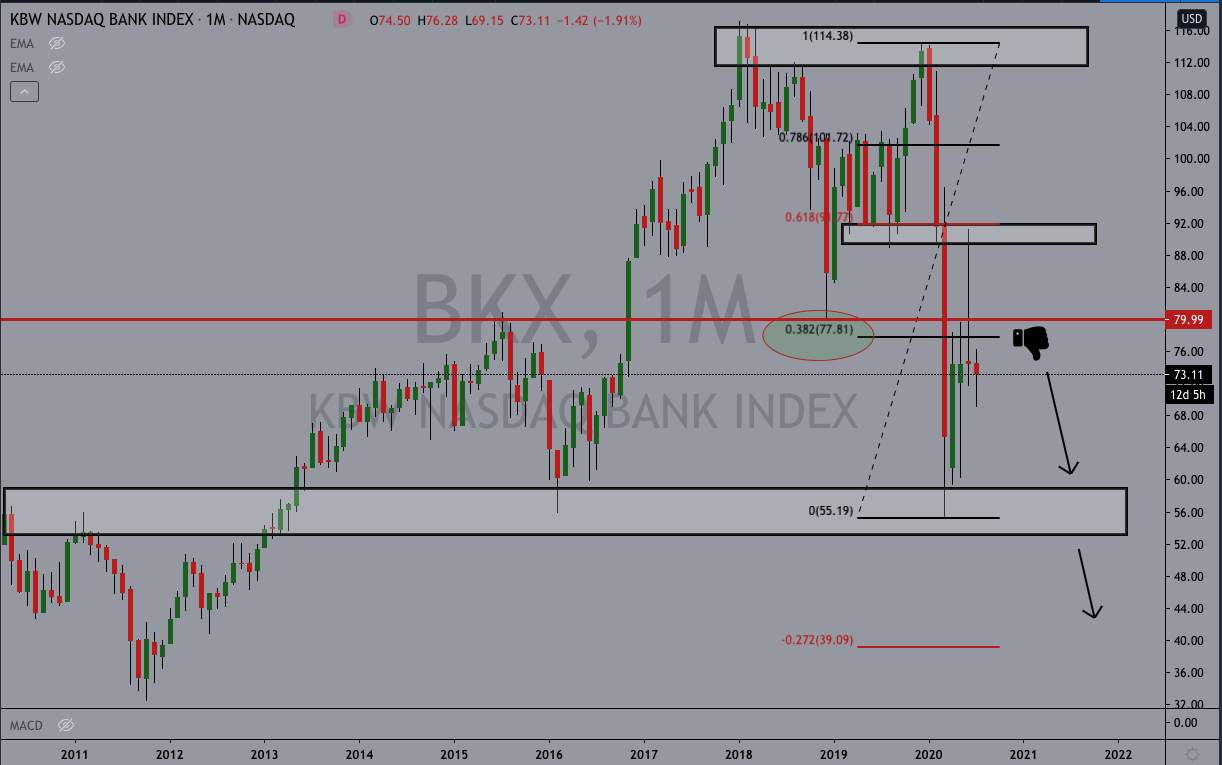
The patterns in these banking indexes are of consolidation, not bottoms. In the above chart, we use the BKX as an example.
The banking sector could be spelling danger ahead.
While we have seen strong technical recoveries elsewhere, particularly in the technology sectors, the banking sector, by comparison, is a rotting carcass which has the GMI Crash Pattern engraved all over it.
The GMI Crash Pattern is one of those patterns seen ahead of waterfall declines.
It is A pattern of a sharp decline followed by a failed rally that does not reach the previous high, or in Elliott Wave terms, the Wave 2 rally. What follows is a collapse.
The week ahead
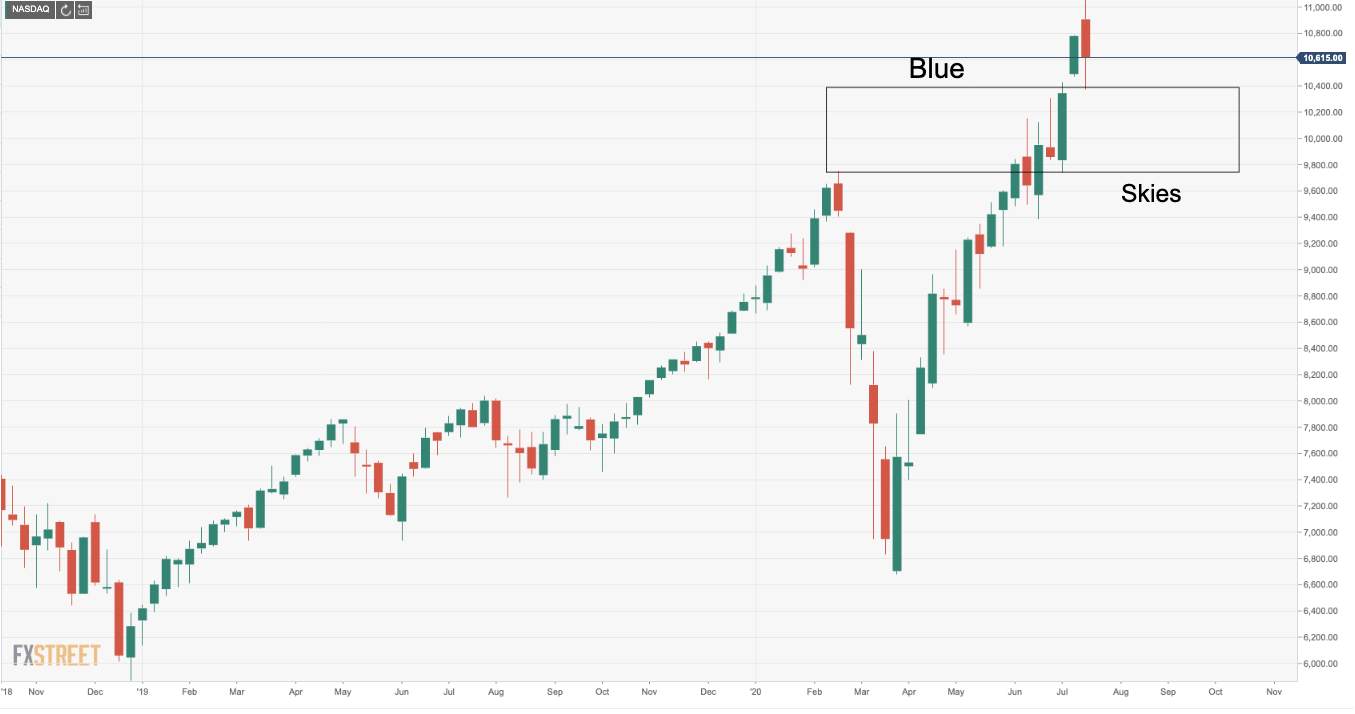
At this juncture, when looking to the benchmarks, if one were to focus on the NDX alone, which has made all-time highs, then this is not a fair assessment of the stock markets or Mainstreet.
The index is a stand-alone phenomenon and deserves a whole article in itself.
(NASDAQ: NDX)
- Willie Nelson
In short, however, the NASDAQ is useful for the purpose of this article to illustrate how the market is positioned – bullish on non-indebted asset classes, such as the technology sector (zero debt, massive cash flows, such as Apple (AAPL), Amazon (AMZN), Microsoft (MSFT) cash-cows) that make up the NDX index.
The NDX has significantly outpacing gains on both the S&P 500 and the Dow.
The big question on Wall Street now is whether the tech-heavy index rocket — driven by spectacular stock gains for the above names — launched too fast?
This week ahead should unveil some truths as tech earnings for the April-to-June period kick-off.
IBM (IBM) is due to report results on Monday, followed by Microsoft on Wednesday and Intel (INTC) on Thursday.
The meteoric rise in tech shares could well be subject to correction at this juncture. The argument here is that so long as the economic recovery playbook maintains traction, we could see a spillover into the laggards, the DJIA and S&P 500.
CNN Business cited a survey conducted by Bank of America this month, which showed that "a record 74% of fund managers said that tech stocks are a "crowded" trade, indicating they see the sector as overvalued and may start looking for opportunities elsewhere."
The economic recovery playbook
The economic recovery playbook, however, may have just turned its last page.
There is a growing body of evidence that this is still a bear market rally.
Again, referring back to the bank's earnings last week, comments from the heads of the banking sector should not be taken lightly.
Jamie Dimon of JPMorgan said that unprecedented economic stimulus measures had delayed the effects he’d expect in a “normal recession,” like falling incomes, savings and property prices.
“It’s just very peculiar times,” he was quoted saying to analysts on a conference call.
Time will play out, but the US record bankruptcies, subsequent ongoing extreme stresses in the jobs market and the insolvency case are hard to ignore.
Meanwhile, on a relatively dull economic calendar, negotiations on another fiscal package will start.
analysts at TD Securities explained.
S&P 500 trendline support is critical
What triggers do we need to see to go from observationally bearish to actually bearish?
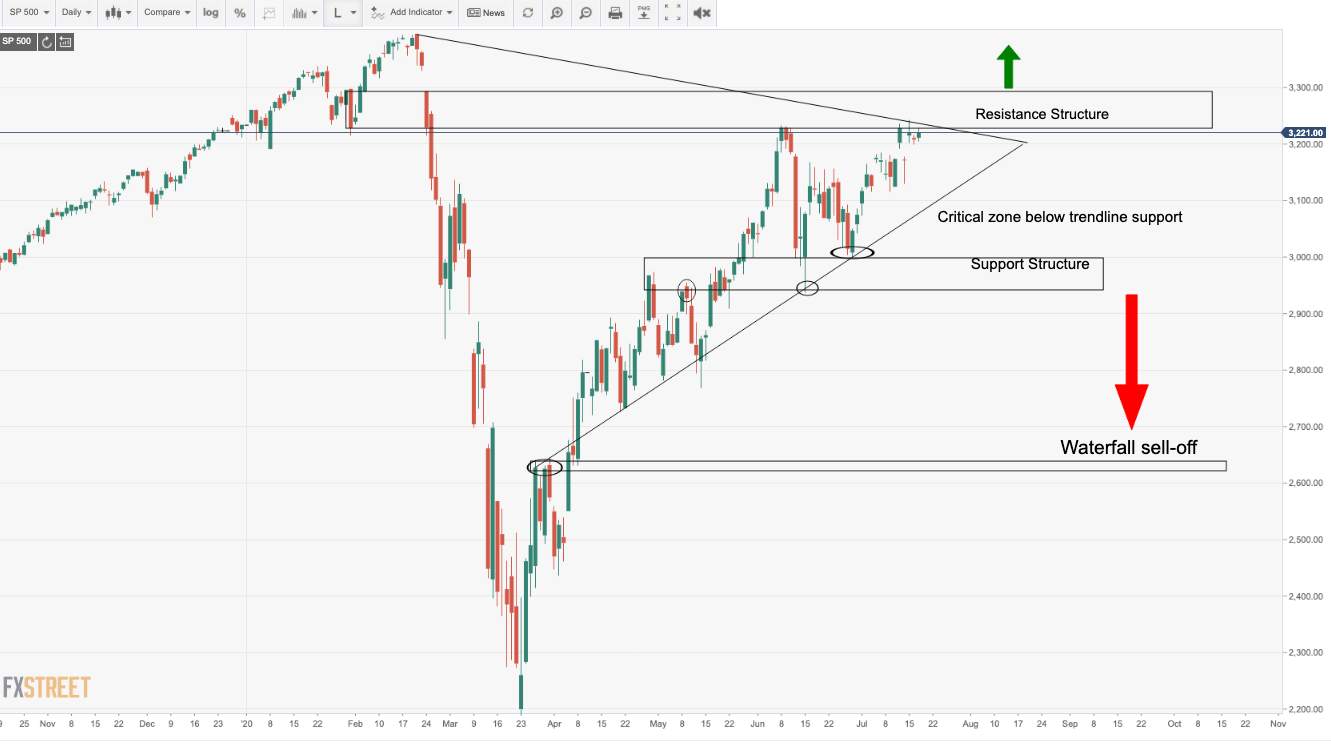
In the above chart, it illustrates how crucial the trendline support is of the symmetrical triangle formation.
Below the Support-Structure opens the prospects of a waterfall style sell-off towards a prior W-formation support level that could act as the last defence.
However, on the upside, so long as the 2020 trendline support holds up, a buy the dips playbook could be the way to go, especially on a break of drawn resistance and subsequent re-tests and holds above the structure. #S&P500##NAS100##DOW##analysis#
Reprinted from Fxstreet,the copyright all reserved by the original author.
免責事項:本記事で述べられている見解は著者の見解のみであり、Followmeの公式見解を反映するものではありません。Followmeは、提供された情報の正確性、完全性、信頼性について一切責任を負いません。また、書面で明示的に記載されている場合を除き、本記事の内容に基づいて行われたいかなる行動についても責任を負いません。

古いコメントはありません。ソファをつかむ最初のものになりましょう。