


EURUSD
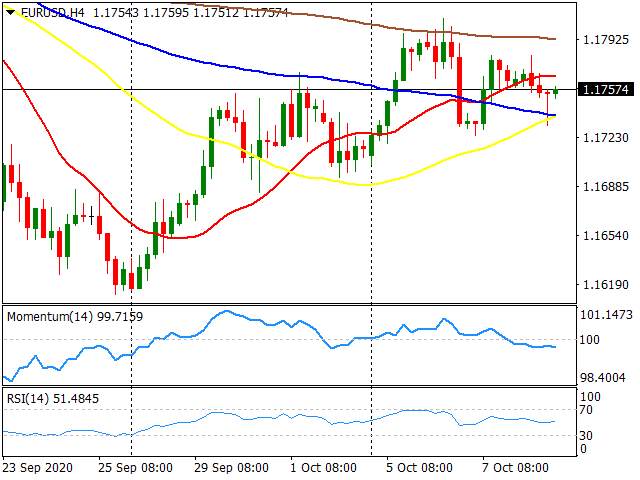
The EUR/USD pair is closing Thursday around 1.1750, virtually unchanged after oscillating between a low of 1.1732 and a high of 1.1781, unable to set a directional short-term bias as markets alternate cautious optimism and a slight recovery of the US dollar. Investors’ attention remains focused on the US stimulus aid package negotiations and the upcoming presidential elections.
On Thursday, the European Central Bank released the ECB Monetary Policy Meeting Accounts, which showed that rate cuts and adjustments to the TLTROs conditions remain a possibility. The Accounts also showed that the recent appreciation of the euro was noticed by the Governing Council. In fact, the higher exchange rate was behind the revision lower in the inflation outlook published in September. Earlier on the day, separated data showed that German Trade Balance shrunk to €15.7 billion during August, with Imports expanding 5.8% and Exports rising 2.4%.
On the other side of the Atlantic, data showed Initial Jobless Claims in the US declined by 9,000 last week to 840,000, although worse than the 820,000 expected. There is no first-tier data scheduled on Friday.
The technical picture for the EUR/USD looks neutral, although slightly tilted to the upside, according to the 4-hour chart following this week rangebound price action. The price consolidates above the 50- and 100-period SMA, which are close to complete a bullish cross at the 1.1740 area, while the 20-period SMA offers immediate resistance at 1.1765. A break here could improve the EUR/USD outlook, with the next upside target at 1.1790 (200-period SMA) and 1.1807, weekly high, ahead of 1.1917, Sep 10 high.
Support levels: 1.1740 1.1725 1.1690
Resistance levels: 1.1765 1.1810 1.1850
USDJPY
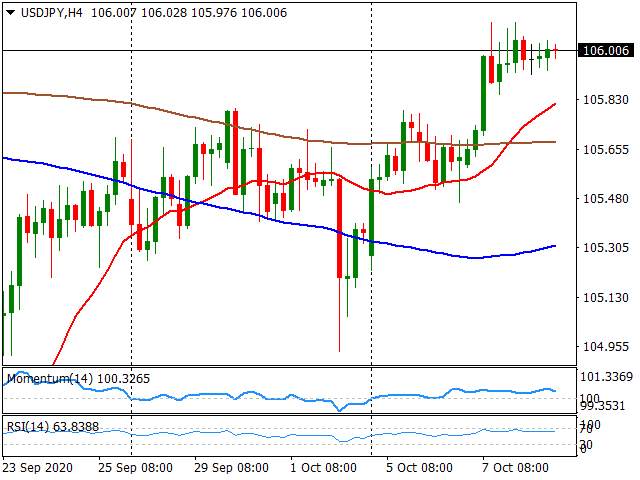
The USD/JPY pair moved all Thursday in a tight range between 105.90 and 106.10, in a quiet session across financial markets. Higher stocks offered support to the pair. Market sentiment continued to improve after Tuesday’s slide and following the Vice Presidential debate in the US and the FOMC minutes. On Thursday, data showed initial jobless claims came in at 840K, above the 820K expected; and continuing claims dropped more than market consensus to 10.98 million. Analysts still see a weak situation in the labor market, reflected claims at historic high levels despite trending lower.
Expectations about more fiscal stimulus contribute cheered investors. On Friday, economic data to be released includes Overall Household Spending in Japan (August) and in the US, Wholesale Inventories (August).
From a technical point of view, the USD/JPY is hovering around 106.00, still bullish in the short-term with the momentum easing. The 4-hour chart shows price above all its key moving averages, with main technical indicators flattening. A break and a consolidation above 106.10 should strengthen the upside bias. On the flip side, under 105.80 the outlook would point to some consolidation ahead in a lower range, probably between 105.45 and 105.80.
Support levels: 105.80 105.40 105.00
Resistance levels: 106.10 106.55 107.00
GBPUSD
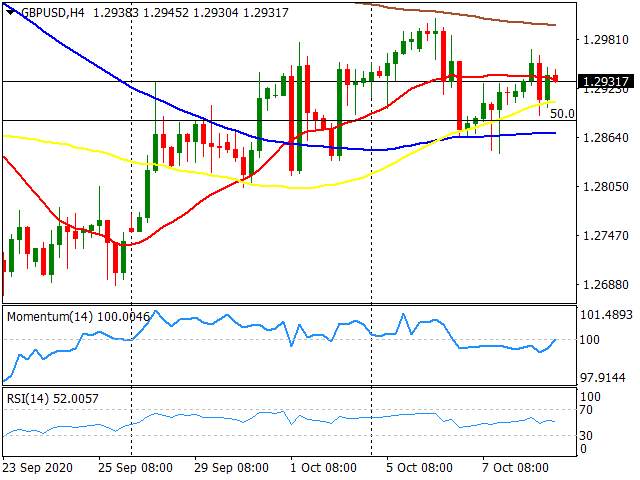
The GBP/USD pair advanced for the second day in a row on Thursday, although the advance was limited as investors continue to assess Brexit news. The cable climbed to a daily high of 1.2970 but came under strong pressure during the European session amid dovish comments from Bank of England Governor Andrew Bailey. The pair briefly dropped below 1.2900 to finally settle at the 1.2935 area in American hours.
Bailey said that the BoE will use policy tools to the fullest extent possible to support the businesses and people, reviving speculations about negative interest rates. BoE governor also said he believed the UK and the European Union should be able to reach a trade deal. Earlier in the day, European Council President Charles Michel noted that coming days will be crucial for Brexit talks and added that they need significant steps from the UK to reach an agreement.
The short-term technical picture has turned mildly positive, with technical indicators gaining bullish slopes in the 4-hour chart, while the GBP/USD pair trades above its main moving averages. However, the 200-period SMA remains elusive and stands as the immediate resistance level at 1.3000. A break above it could pave the way toward next significant resistance at 1.3030 (50-day SMA). On the other hand, initial support stands at the 20-day SMA at the 1.2860 zone, followed by the more significant 1.2800-1.2790 area, where the psychological hurdle converges with the 100-day SMA.
Support levels: 1.2900 1.2860 1.2800
Resistance levels: 1.3000 1.3030 1.3100
AUDUSD
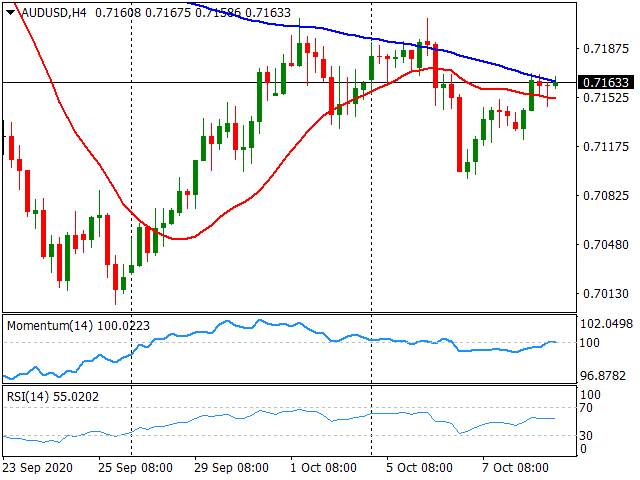
The Aussie rose across the board during the Asian session, boosted partially by a rally in AUD/NZD. It then pulled back with AUD/USD holding onto daily gains supported by moderate risk appetite. Equity prices ended higher in Wall Street on the back of expectations about more fiscal stimulus in the US. Comments about stimulus could continue to weigh on markets. In the US, initial jobless claims dropped less than expected to 840K while continuing claims came in better-than-expected falling under 11 million. On Friday, data to be released includes the Home Loans in Australia, the Financial Stability Review from the Reserve Bank of Australia and the Chinese Caixin Service PMI for September, all during the Asian session.
The AUD/USD in the 4-hour chart is testing the 20-SMA around 0.7165, level located near the 0.7170 resistance zone. A break higher would strengthen the Aussie that could rise toward 0.7200. A daily close above 0.7200 could sign that a temporary bottom is in place. Lack of interest from buyers at the current level should lead to another test of 0.7140 during the Asian session. More sellers are likely to arise under 0.7140. The next critical support stands around the 0.7095 area (September low).
Support levels: 0.7145 0.7100 0.7060
Resistance levels: 0.7170 0.7210 0.7250
GOLD
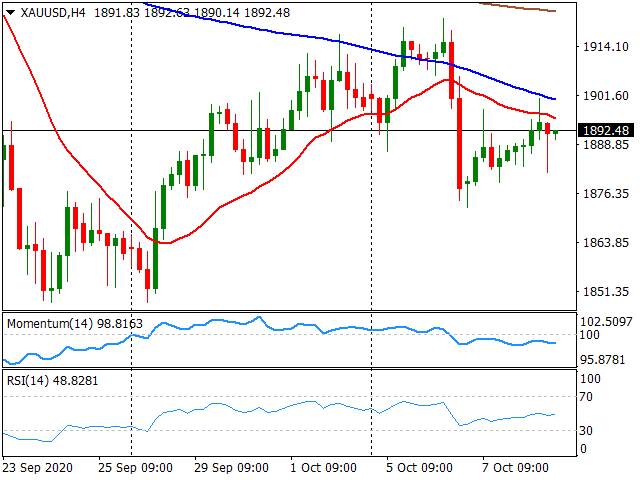
Gold advanced its move on Thursday while the USD index DXY was virtually unchanged in an uneventful trading day. However, the yellow metal failed to surpass $1,900 following Tuesday’s crash from $1,921. US markets also kept their positive mood on Thursday after renewed optimism regarding stimulus talks after Trump ended the negotiations. Also, yields in the US declined after a less than expected decline in US jobless claims, which indicated that the US jobs market was still under pressure.
Gold managed to get away from the critical support zone at $1,860. Below this level, the supports can be followed at $1,763 ($1,451-$2,075 61.80%) and $1,700 levels. Over the $1,860 level, the resistances can be followed at $1,900 with $1,956 ($1,451-$2,075 38.20%) and $2,000 levels.
Support Levels: $1,860 $1,763 $1,700
Resistance Levels: $1,900 $1,956 $2,000
SILVER
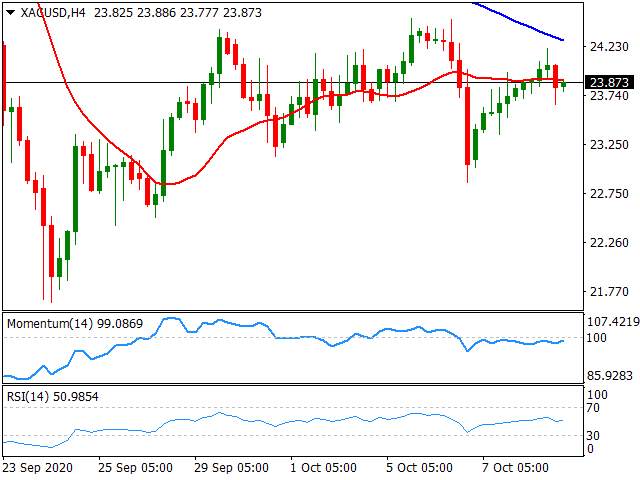
Silver also had a slightly positive trading day on Thursday trying to erase losses made on Tuesday. However, the white metal failed to crack the $24.00 level while the USD index DXY remains almost unchanged. Reflecting the limited range trading seen in precious metals, Gold to Silver ratio also kept its stance around 79.00 levels. Lately, Silver outperforms Gold in risk-on trading sessions therefore, Silver promises bigger value gains in future as its ratio to Gold is still way over the median levels.
Below the $22.90 level ($11.63-$29.86 38.20%), the supports can be followed at $20.75 ($11.63-$29.86 50.00%) and $18.42 ($11.63-$29.86 61.80%). Over the $22.90 level, the targets up can be followed at $25.21 ($11.63-$29.86 23.60%), $26.00 (August-September support), $27.00 and $28.00 levels.
Support Levels: $22.90 $20.75 $18.42
Resistance Levels: $25.21 $26.00 $27.00
CRUDE WTI
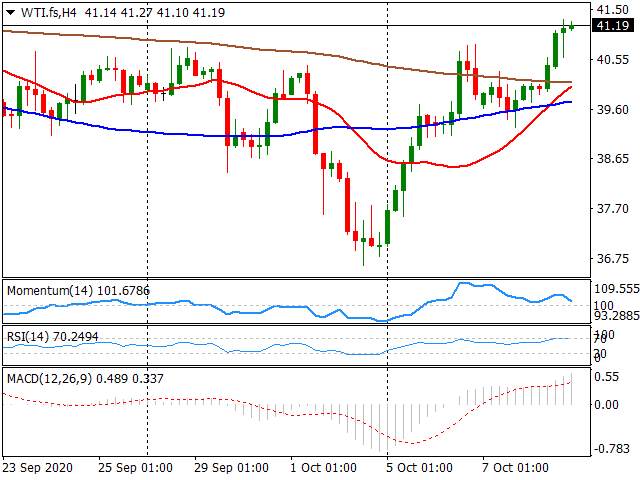
WTI jumped to its highest level since the start of September with disruptions in supply. Due to the latest reports, Hurricane Delta is expected to emerge into a category-3 hurricane in the Gulf Coast resulting in nearly 1.5 million barrels of daily output has been halted. On the other hand, the ongoing strike in Norway could reportedly extend to the country's largest oil field, Johan Sverdrup, and cause an additional decline of 470,000 barrels per day in the country's oil output. While oil found support with supply problems limiting production, on the demand side, ongoing uncertainty regarding stimulus talks is limiting WTI’s advance. Weekly stock build-up was slightly over the estimates as Crude Oil Stocks Change in the US was +0.5 million barrels in the week ending October 2nd, the weekly report published by the US Energy Information Administration (EIA) revealed on Wednesday. Analysts estimate was for an increase of 0.3 million barrels.
If WTI manages to hold over $40.56 ($65.62-$0.00 61.80%) level, the targets upside can be followed at $41.00, $46.57 (March decline start) and $50.00 levels. Below $40.00, the supports can be followed at $39.00 and $32.81 ($65.62-$0.00 50.00%) and $31.00 levels.
Support Levels: $39.00 $32.81 $31.00
Resistance Levels: $41.00 $46.57 $50.00
DOW JONES
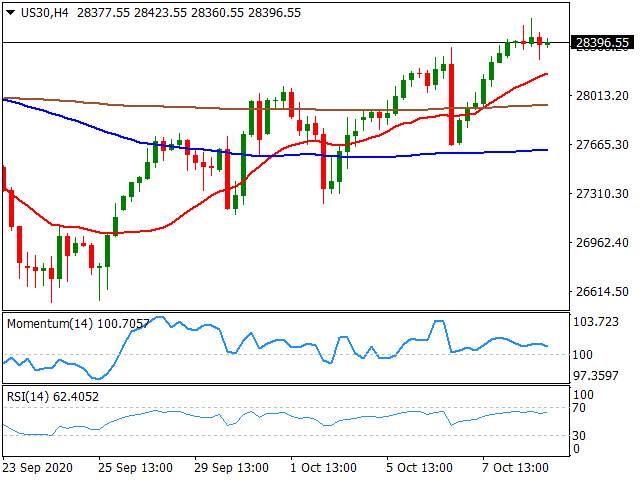
Dow Jones kept its move up and tested its highest level since the start of September. At this point, markets in the US are focused on stimulus gridlock and upcoming elections. Due to latest polls, Biden has a clear lead in the race. However, a mixed result with Republicans controlling the Congress might create further uncertainty. On the other hand, US House Speaker Nancy Pelosi noted on Thursday that there will not be a standalone airline bill without a comprehensive COVID relief bill, as reported by Reuters. At this point, markets are pricing an agreement before the election which looks unlikely under current conditions. On the data side, more than 840k Americans filed for unemployment benefits in the previous week. The figure was worse than the estimate of 820k by a panel of economists polled by Reuters but lower than last week’s reading of 849k.
From the technical point of view, over the physiological 28,000 level, 28,400 with 29,000 and 29,500 can be followed as next resistance while below 27,770 level the supports can be seen at 27,400, with 27,000 and 26,757 (24,680-27,400 23.60%) levels.
Support Levels: 27,700 27,400 27,000
Resistance Levels: 28,400 29,000 29,500
MACROECONOMIC EVENTS
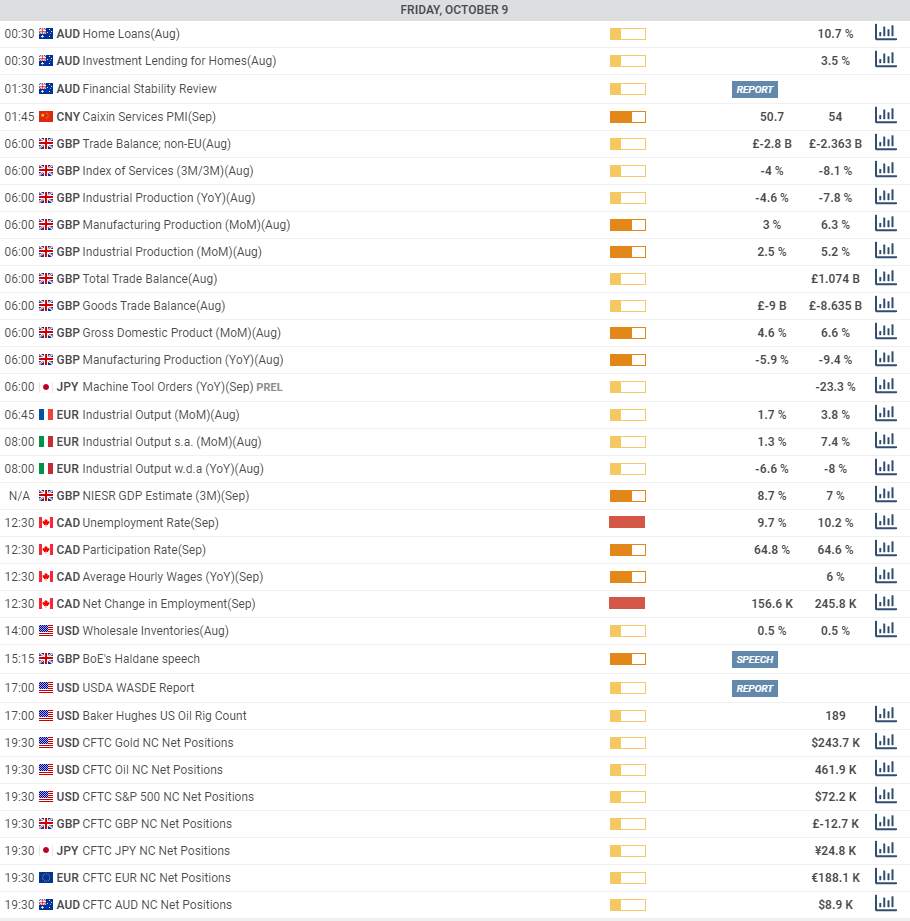
* All the Moving Average support and resistance levels are dynamic by nature. Means when the price approaches the Moving averages, slight variation occurs in the forecasted Moving Average support and resistance levels. Previous few days’ intraday levels are also signicant while trading the current day as the price tend to hover around these levels for some time. Levels in red indicate strong, critical or vital.
Please remember that trading financial markets carry a high degree of risk to your capital. It is possible to lose more than your initial stake. Leveraged products may not be suitable for all investors, therefore please ensure you fully understand the risks involved and seek independent advice if necessary.
All Rights Reserved © Noor Al Mal
#交易者的双节##国庆假期精神爽##易路有你,从不孤单##2020年美国大选##9月非农爆冷下滑#
免責事項:本記事で述べられている見解は著者の見解のみであり、Followmeの公式見解を反映するものではありません。Followmeは、提供された情報の正確性、完全性、信頼性について一切責任を負いません。また、書面で明示的に記載されている場合を除き、本記事の内容に基づいて行われたいかなる行動についても責任を負いません。

古いコメントはありません。ソファをつかむ最初のものになりましょう。