


To increase your chances of profitability, you want to trade when you have the potential to make 3 times more than you are risking.
If you give yourself a 3:1 reward-to-risk ratio, you have a significantly greater chance of ending up profitable in the long run.
Take a look at the chart below as an example:
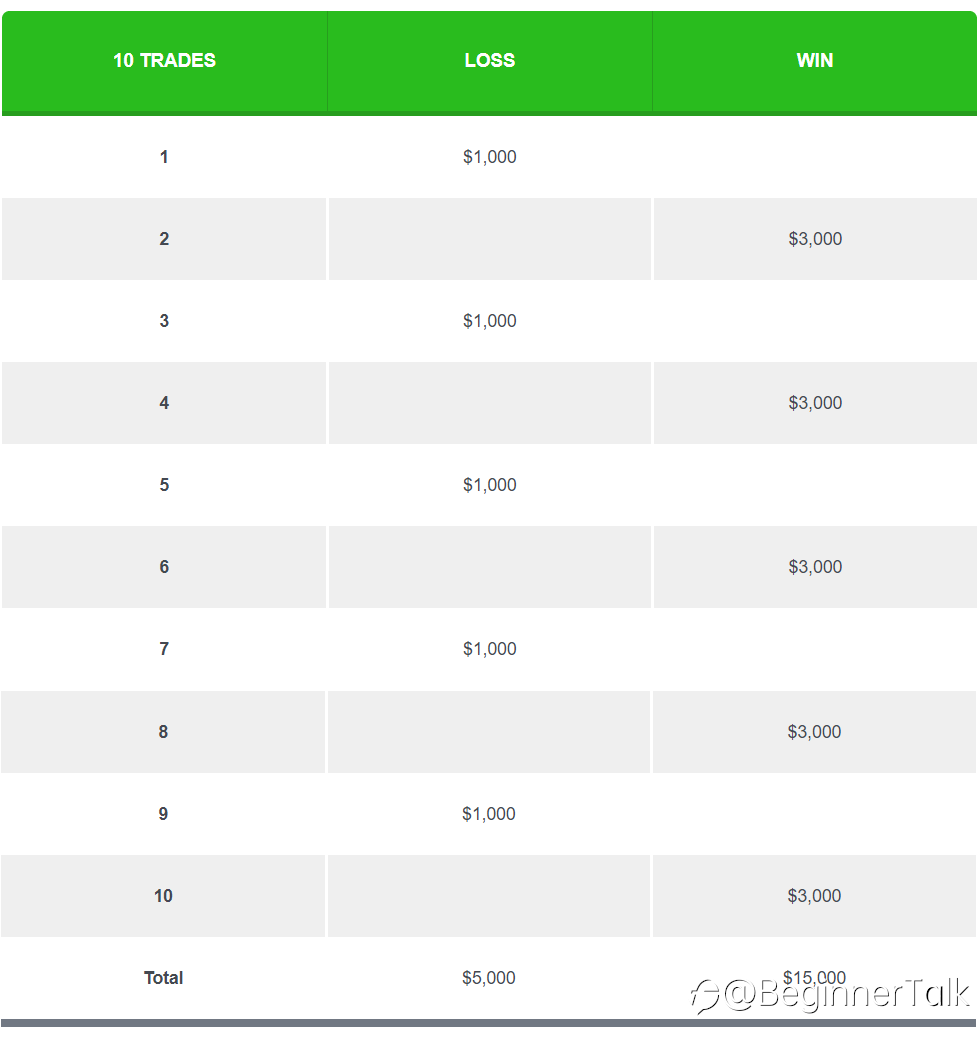
In this example, you can see that even if you only won 50% of your trades, you would still make a profit of $10,000.
Just remember that whenever you trade with a good risk to reward ratio, your chances of being profitable are much greater even if you have a lower win percentage.
BUT…
And this is a big one.. setting a large reward-to-risk ratio comes at a price.
On the very surface, the concept of putting a high reward-to-risk ratio sounds good, but think about how it applies in actual trade scenarios.
Let’s say you are a scalper and you only wish to risk 3 pips.
Using a 3:1 reward to risk ratio, means you need to get 9 pips. Right off the bat, the odds are against you because you have to pay the spread.
If your broker offered a 2 pip spread on EUR/USD, you’ll have to gain 11 pips instead, forcing you to take a difficult 4:1 reward to risk ratio.
Considering the exchange rate of EUR/USD could move 3 pips up and down within a few seconds, you would be stopped out faster than you can say “Uncle!”
If you were to reduce your position size, then you could widen your stop to maintain your desired reward/risk ratio.
Now, if you increased the pips you wanted to risk to 50, you would need to gain 153 pips.
By doing this, you are able to bring your reward-to-risk ratio somewhere nearer to your desired 3:1. Not so bad anymore, right?
In the real world, reward-to-risk ratios aren’t set in stone. They must be adjusted depending on the time frame, trading environment, and your entry/exit points.
A position trade could have a reward-to-risk ratio as high as 10:1 while a scalper could go for as little as 0.7:1.
Reprinted from Babypips, the copyright all reserved by the original author.
免責事項:本記事で述べられている見解は著者の見解のみであり、Followmeの公式見解を反映するものではありません。Followmeは、提供された情報の正確性、完全性、信頼性について一切責任を負いません。また、書面で明示的に記載されている場合を除き、本記事の内容に基づいて行われたいかなる行動についても責任を負いません。

