



In Elliott Wave Theory, the traditional definition of motive wave is a 5 wave move in the same direction as the trend of one larger degree. There are three different variations of a 5 wave move which is considered a motive wave: Impulse wave, Impulse with extension, and diagonal.
EWF prefers to define motive wave in a different way. We agree that motive waves move in the same direction as the trend and we also agree that 5 waves move is a motive wave. However, we think that motive waves do not have to be in 5 waves. In today’s market, motive waves can unfold in 3 waves. For this reason, we prefer to call it motive sequence instead.
3.1 Impulse
Guidelines
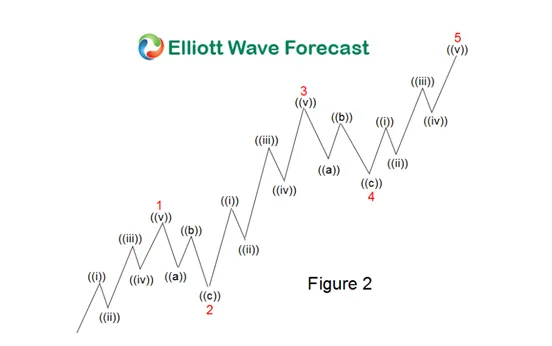
- • Impulse wave subdivide into 5 waves. In Figure 2, the impulse move is subdivided as 1, 2, 3, 4, 5in minor degree
- • Wave 1, 3, and 5 subdivision are impulse. The subdivision in this case is ((i)), ((ii)), ((iii)), ((iv)), and ((v)) in minute degree.
- • Wave 2 can’t retrace more than the beginning of wave 1
- • Wave 3 can not be the shortest wave of the three impulse waves, namely wave 1, 3, and 5
- • Wave 4 does not overlap with the price territory of wave 1
- • Wave 5 needs to end with momentum divergence
Fibonacci Ratio Relationship
- • Wave 2 is 50%, 61.8%, 76.4%, or 85.4% of wave 1
- • Wave 3 is 161.8%, 200%, 261.8%, or 323.6% of wave 1-2
- • Wave 4 is 14.6%, 23.6%, or 38.2% of wave 3 but no more than 50%
- • There are three different ways to measure wave 5. First, wave 5 is inverse 123.6 – 161.8% retracement of wave 4. Second, wave 5 is equal to wave 1. Third, wave 5 is 61.8% of wave 1-3
3.2 Impulse with Extension
Guidelines
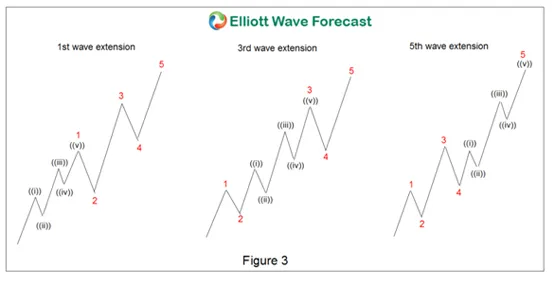
- • Impulses usually have an extension in one of the motive waves (either wave 1, 3, or 5)
- • Extensions are elongated impulses with exaggerated subdivisions
- • Extensions frequently occur in the third wave in the stock market and forex market. Commodities market commonly develop extensions in the fifth wave
3.3 Leading Diagonal
Guidelines
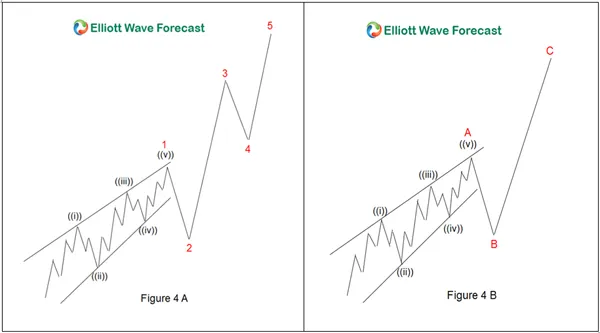
- • Special type of motive wave which appears as subdivision of wave 1 in an impulse or subdivision of wave A in a zigzag
- • In Figure 4A, the leading diagonal is a subdivision of wave 1 in an impulse. In Figure 4B, the leading diagonal is a subdivision of wave A in a zigzag
- • Leading diagonal is usually characterized by overlapping wave 1 and 4 and also by the wedge shape but overlap between wave 1 and 4 is not a condition, it may or may not happen
- • The subdivision of a leading diagonal can be 5-3-5-3-5 or 3-3-3-3-3. The examples above show a leading diagonal with 5-3-5-3-5 subdivision
3.4 Ending Diagonal
Guidelines
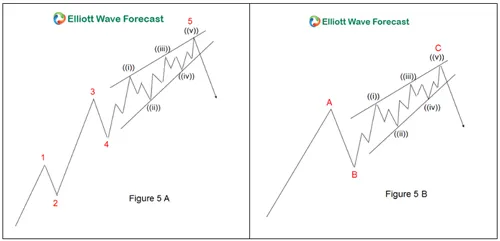
- • Special type of motive wave which appears as subdivision of wave 5 in an impulse or subdivision of wave C in a zigzag
- • In Figure 5A, the ending diagonal is a subdivision of wave 5 in an impulse. In Figure 5B, the ending diagonal is a subdivision of wave C in a zigzag
- • Ending diagonal is usually characterized by overlapping wave 1 and 4 and also by the wedge shape. However, overlap between wave 1 and 4 is not a condition and it may or may not happen
- • The subdivision of an ending diagonal is either 3-3-3-3-3 or 5-3-5-3-5
3.5 Motive Sequence
Motive waves move in the same direction of the primary trend, but in today’s time, we believe it doesn’t necessarily have to be in impulse. We instead prefer to call it motive sequence.We define a motive sequence simply as an incomplete sequence of waves (swings). The structure of the waves can be corrective, but the sequence of the swings will be able to tell us whether the move is over or whether we should expect an extension in the existing direction.
Motive sequence is much like the Fibonacci number sequence. If we discover the number of swings on the chart is one of the numbers in the motive sequence, then we can expect the current trend to extend further.
25 Mar 2022, 16:28 を編集しました
免責事項:本記事で述べられている見解は著者の見解のみであり、Followmeの公式見解を反映するものではありません。Followmeは、提供された情報の正確性、完全性、信頼性について一切責任を負いません。また、書面で明示的に記載されている場合を除き、本記事の内容に基づいて行われたいかなる行動についても責任を負いません。

古いコメントはありません。ソファをつかむ最初のものになりましょう。