


| Scenario | |
|---|---|
| Timeframe | Intraday |
| Recommendation | SELL STOP |
| Entry Point | 1.1045 |
| Take Profit | 1.0964 |
| Stop Loss | 1.1090 |
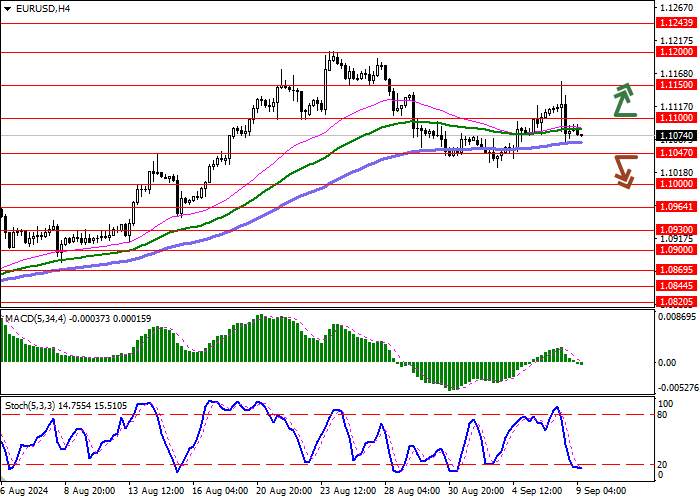
| Key Levels | 1.0930, 1.0964, 1.1000, 1.1047, 1.1100, 1.1150, 1.1200, 1.1243 |
| Alternative scenario | |
|---|---|
| Recommendation | BUY STOP |
| Entry Point | 1.1100 |
| Take Profit | 1.1200 |
| Stop Loss | 1.1047 |
| Key Levels | 1.0930, 1.0964, 1.1000, 1.1047, 1.1100, 1.1150, 1.1200, 1.1243 |
Current trend
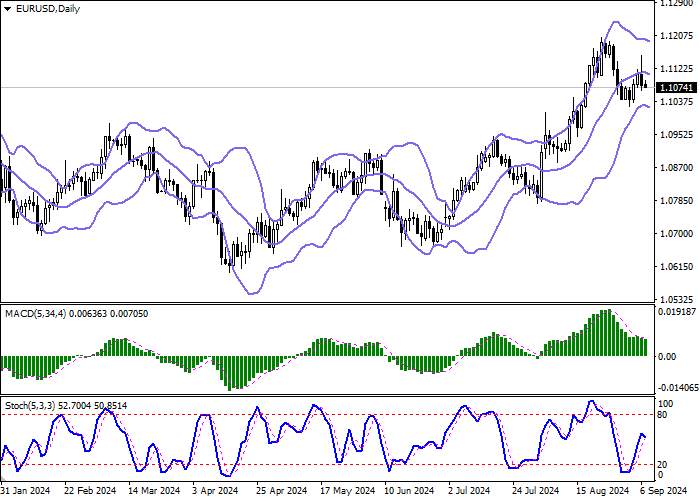
The EUR/USD pair shows ambiguous trading dynamics, consolidating near 1.1075. Market activity remains subdued at the start of the new week, with investors' focus on macroeconomic data from the EU and the US.
The American currency reacted to the publication of the August report on the labor market: the biggest disappointment was the revision of Non-Farm Payrolls in July from 114.0 thousand to 89.0 thousand, before rising to 142.0 thousand, below the expected 160.0 thousand. Average Hourly Earnings accelerated more than expected, from 0.2% to 0.4% month-on-month and from 3.6% to 3.8% year-on-year, while analysts had expected 0.3% and 3.7%, respectively.
Against this backdrop, market participants did not revise their forecasts regarding the expected reduction in the cost of borrowing by the US Federal Reserve in September: at present, the probability of the scenario with an interest rate adjustment of –50 basis points is estimated at no more than 35.0%, and it is unlikely to increase significantly in the remaining time. At the same time, on Wednesday, the US will release August inflation statistics to the market, forecasts for which suggest a slowdown in annual dynamics from 2.9% to 2.6%.
In European data, markets took note of a 2.4% contraction in German Industrial Production in July, following a 1.7% rise in the previous month, while analysts had expected a –0.3% drop, and the annual figure fell from –3.7% to –5.3%.
Investors are confident of a cut in borrowing costs by the European Central Bank (ECB) at 14:45 (GMT 2) on Thursday, expecting a continuation of the "dovish" rhetoric in October. Since the last meeting, inflation has fallen to a two-year low of 2.2% in August, with Germany and Spain reporting bigger-than-expected declines, but in the eurozone as a whole, services prices have risen to 4.2%, which some economists attribute to the Olympic and Paralympic Games in Paris this summer. Analysts expect the interest rate to be adjusted by another –25 basis points to 4.0%. Last month, ECB chief economist Philip Lane said keeping the rate too high for too long would push inflation below the 2.0% target in the medium term.
Support and resistance
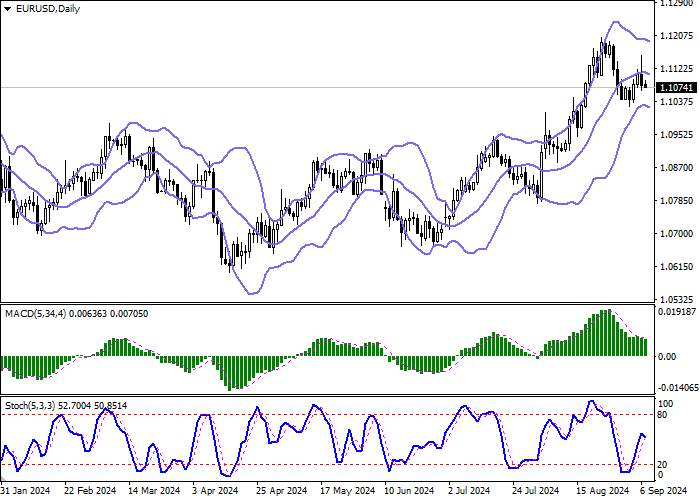
On the daily chart, Bollinger Bands are gradually reversing horizontally. The price range is slightly changing, reflecting ambiguous dynamics of trading in the short term. MACD is declining keeping a weak sell signal (located below the signal line) Stochastic, having reacted to the emergence of "bearish" dynamics at the end of last week, also reversed into a downward plane, located approximately in the center of its area.
Resistance levels: 1.1100, 1.1150, 1.1200, 1.1243.
Support levels: 1.1047, 1.1000, 1.0964, 1.0930.
Trading tips
Short positions may be opened after a breakdown of 1.1047 with the target at 1.0964. Stop-loss — 1.1090. Implementation time: 2-3 days.
The return of the "bullish" trend with the breakout of 1.1100 may become a signal to open long positions with the target at 1.1200. Stop-loss — 1.1047.
免責事項:本記事で述べられている見解は著者の見解のみであり、Followmeの公式見解を反映するものではありません。Followmeは、提供された情報の正確性、完全性、信頼性について一切責任を負いません。また、書面で明示的に記載されている場合を除き、本記事の内容に基づいて行われたいかなる行動についても責任を負いません。

古いコメントはありません。ソファをつかむ最初のものになりましょう。