


BREAKING FOREX
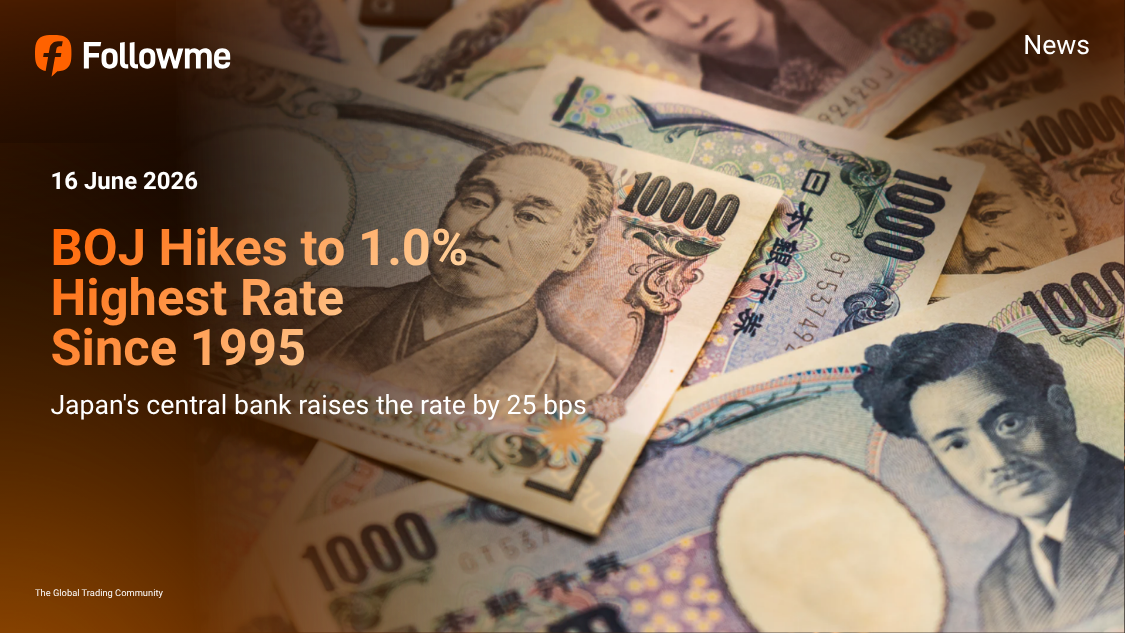
BOJ Hikes to 1.0% Highest Rate Since 1995
Japan's central bank raises the overnight call rate by 25 bps in a 7-1 vote, with Governor Ueda absent due to hospitalisation. Rate effective June 17.
Followme News Desk | June 16, 2026, Tokyo | Source: BOJ Monetary Policy Statement k260616a
New Rate: 1.0% | Previous: 0.75% | Vote: 7–1 | Effective: Jun 17, 2026
What Happened
The Bank of Japan's Policy Board voted 7 to 1 to set the uncollateralized overnight call rate at 1.0%, up from 0.75% — the highest level in 31 years. In the same 7-1 vote, the Bank raised the complementary deposit facility rate to 1.0% and the basic loan rate under the complementary lending facility to 1.25%. Both changes take effect June 17, 2026.
The meeting was chaired by Deputy Governor Ryozo Himino after Governor Kazuo Ueda, 74, was hospitalised on June 10 for treatment of an infected liver cyst. Deputy Governor Shinichi Uchida is conducting the post-meeting press conference.
The sole dissenter, board member ASADA Toichiro, voted against the hike on the grounds that downside risks to production and employment from the Middle East situation outweighed upside risks to prices, and that it was preferable to maintain the existing money market operations guideline.
Why They Moved
The BOJ's statement pointed to a combination of a moderately recovering economy and mounting price pressures driven by the ongoing Middle East conflict. While headline CPI (excluding fresh food) has recently been running at around 1.5% — held below 2% by government energy-subsidy measures — the Bank flagged that the pass-through of crude oil price rises in business-to-business transactions is accelerating at a relatively fast pace, and risks spreading to a wide range of consumer prices.
Medium- to long-term inflation expectations have also continued to rise, creating a risk of underlying CPI deviating upward above the 2% price stability target. At the same time, corporate profits have remained at high levels and the labour market has stayed tight, keeping the wage-price cycle intact.
BOJ's Rationale (from official statement) "In view of these developments in economic activity and prices as well as financial conditions, the Bank judged it appropriate to adjust the degree of monetary accommodation from the perspective of sustainable and stable achievement of the price stability target of 2 percent. Accommodative financial conditions are expected to be maintained after the change in the policy interest rate."
Forward Guidance — The Market Mover
The BOJ was explicit: this is not the end. The official statement said the Bank will continue to raise the policy interest rate and adjust the degree of monetary accommodation, in response to developments in economic activity and prices as well as financial conditions.
"The Bank will continue to raise the policy interest rate and adjust the degree of monetary accommodation, in response to developments in economic activity and prices as well as financial conditions."
The Bank said it will closely monitor the future course of the Middle East situation and its impact on Japan's economy and prices, as well as developments in global AI-related demand and foreign exchange rates. Underlying CPI inflation is projected to increase gradually, reaching levels broadly consistent with the 2% price stability target between the second half of fiscal 2026 and fiscal 2027.
Vote Breakdown
| Board Member | Vote |
|---|---|
| HIMINO Ryozo (Chair, Deputy Governor) | ✔ For |
| UCHIDA Shinichi (Deputy Governor) | ✔ For |
| NAKAGAWA Junko | ✔ For |
| TAKATA Hajime | ✔ For |
| TAMURA Naoki | ✔ For |
| KOEDA Junko | ✔ For |
| MASU Kazuyuki | ✔ For |
| ASADA Toichiro | ✘ Against |
| UEDA Kazuo (Governor) | — Absent (hospitalised) |
Note: Takata and Tamura dissented on the inflation outlook language in the attached economic assessment, both arguing underlying CPI had already broadly reached the 2% target.
USD/JPY — Live Price Chart
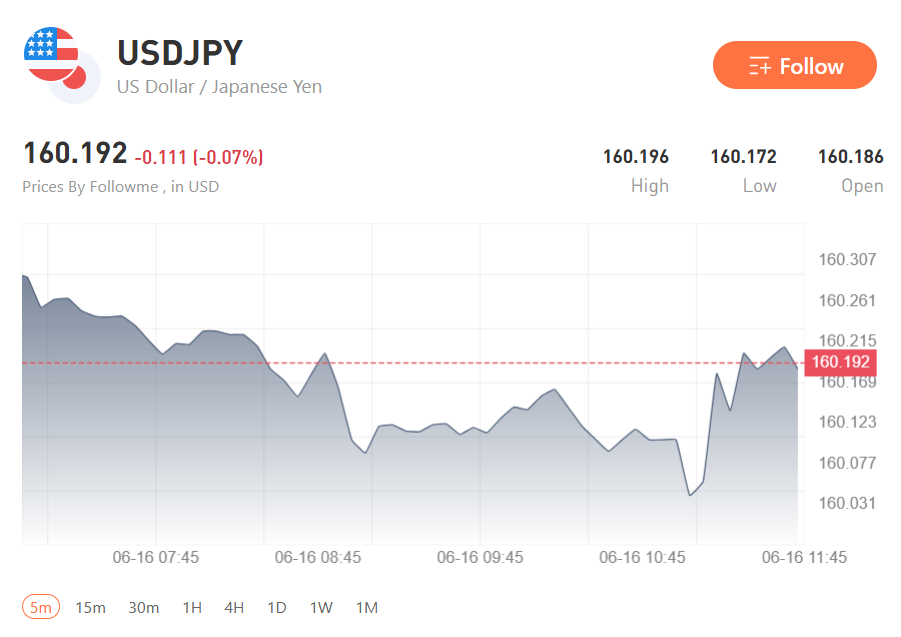
USD/JPY 160.25 as of Jun 16, 2026 — View Live Chart →
What Traders Should Watch Now
The hike itself was priced in at ~97% probability ahead of the announcement, meaning the JPY reaction to the rate decision alone may be limited. The real drivers from here:
- Uchida's press conference tone. Any hawkish signal on the pace or timing of the next hike could push USD/JPY lower sharply. Watch for any language around October 2026.
- USD/JPY and the ¥160 line. The pair was trading above ¥160 ahead of the decision — a level historically associated with Japanese authorities intervening. A sustained break below ¥160 is the key technical trigger.
- Bond purchase outlook. The BOJ is considering pausing its JGB tapering to stabilise a bond market rattled by Middle East inflation risks. A pause could be read as relatively dovish and cap JPY upside.
- Carry trade unwind risk. Every BOJ hike since March 2024 has triggered yen carry trade unwinding. With yen short positions still near multi-year highs, positioning risk is elevated. Watch equities and EM currencies for spillover.
- Middle East ceasefire developments. A US-Iran deal extending the Strait of Hormuz ceasefire is reportedly underway. Any resolution could ease oil-driven inflation pressure and complicate the BOJ's case for rapid further tightening.
Bottom Line The move was expected. What is not fully priced is the speed of the next hike. Forward guidance is hawkish, the economy is holding up, and inflation risks are skewed upward. Markets are pricing at least one more 25 bps hike by year-end. Watch Uchida's presser for confirmation.
Source: Bank of Japan — Statement on Monetary Policy, June 16, 2026 (k260616a.pdf) | New rate effective June 17, 2026 | This report is for informational purposes only and does not constitute financial advice. © 2026 Followme News




免責事項:本記事で述べられている見解は著者の見解のみであり、Followmeの公式見解を反映するものではありません。Followmeは、提供された情報の正確性、完全性、信頼性について一切責任を負いません。また、書面で明示的に記載されている場合を除き、本記事の内容に基づいて行われたいかなる行動についても責任を負いません。

古いコメントはありません。ソファをつかむ最初のものになりましょう。