


· Views 12,543
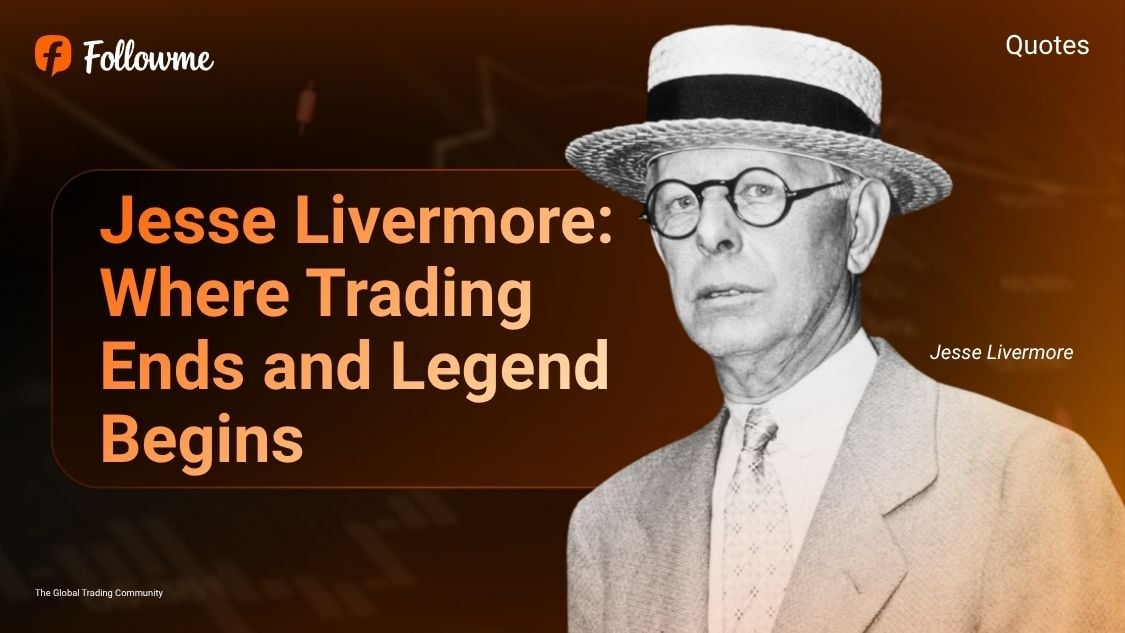
In the autumn of 1929, while Wall Street burned, one man stood calmly on the trading floor of the New York Curb Exchange, watching the tape unravel into chaos. As stocks collapsed and fortunes evaporated around him, he reportedly repeated four words to his brokers: "let it come." By the time the dust settled, Jesse Livermore had made roughly $100 million, somewhere north of $1.5 billion in today's money, making him one of the richest men on the planet.
A century later, nearly every "basic" rule of trading still traces back to him. This is the story of how a teenager with a notebook became the most studied speculator in Wall Street history.
The Boy Who Read the Tape
Livermore's story didn't start on Wall Street. It started in a Boston bucket shop an informal betting parlor where people wagered on stock price movements without ever owning a single share. He was fourteen, working as a chalkboard runner, updating prices by hand. Watching those numbers scroll past day after day, he began noticing something most people didn't pattern. Prices didn't move randomly. They tended to repeat, retest old highs and lows, and behave differently depending on how heavily a stock was traded.
He started keeping a notebook of these observations effectively his own early form of technical analysis, decades before the term existed. At fifteen, he placed his first bet $5 on railroad stock called Burlington, based purely on what his notes told him the pattern suggested. Two days later, he walked away with a profit of $3.12. It wasn't much money, but it was proof of concept: prices could be read, and read profitably.
By twenty, he had turned that into roughly $10,000, a small fortune at the time. He'd been so consistently successful that the bucket shops, one by one, banned him from trading. He was, quite literally, too good to be allowed to keep playing a rigged game. So he moved to New York to test his methods against the real market where execution delays and genuine order flow meant the tape no longer behaved quite the same way, forcing him to relearn parts of his craft from scratch.
The Method Behind the Myth
What made Livermore dangerous wasn't luck. It was a repeatable process, built and refined over decades of real money on the line.
He read price action over opinion. His defining principle, still quoted by traders today, was simple: the market is never wrong. He didn't trade based on tips, news, or conviction about what should happen. He watched what was actually happening in price and volume, and acted on that alone.
He waited for "pivotal points." Livermore identified specific price levels where, in his observation, a stock was most likely to make a significant move, either confirming a trend or reversing it. Rather than guessing where a move would happen, he waited for prices to reach these levels before committing capital.
He scaled in on confirmation, not conviction. Livermore rarely bet his full size on a single entry. He would test a position small near a pivotal point, and only add aggressively once the market proved him right. This meant his biggest losses were always small, and his biggest wins were allowed to compound.
He cut losses fast and let winners run. This sounds obvious now, precisely because Livermore is one of the people who made it obvious. In an era when most speculators held onto losing positions hoping for a turnaround, Livermore treated a small loss as the cost of being wrong quickly, far cheaper than being wrong slowly.
He traded with the trend, never against it. He believed individual stocks rarely moved in isolation. They moved with sectors, and sectors moved with the broader market. Reading the trend of the market as a whole, rather than fixating on a single stock, shaped nearly every major trade he made.
This combination of discipline produced two of the most legendary trades in Wall Street history. In 1907, he shorted the market during that year's Panic, making roughly a million dollars in a single day so much, so fast, that J.P. Morgan himself reportedly asked him to ease off, fearing his selling would deepen the crisis.
The Trade That Defined a Career
By the late 1920s, while the rest of the country partied through the bull market, Livermore watched the excess pile up, heavy speculation, heavy leverage, and a widespread conviction that stocks could only go up. He didn't buy the story. Through the summer and fall of 1929, he quietly built a substantial short position, deliberately spreading his trades across more than 100 different stockbrokers so no single broker could see the full scale of his bet.
When the crash hit that October, he was ready. While panic spread across the floor, Livermore executed calmly, adding to his short positions as the market confirmed his thesis was correct. The result was an estimated $100 million in profit proof, on the largest scale imaginable, that a process built on reading price action could outperform a market built on belief.
The Playbook He Left Behind
Livermore's life became the basis for Reminiscences of a Stock Operator, the 1923 book by Edwin Lefèvre that is still, a century later, recommended to nearly every new trader who asks where to start. Paul Tudor Jones has cited it as a major influence. Market Wizards author Jack Schwager calls it one of the most-referenced books among the traders he's interviewed over the decades. Livermore later distilled his own principles directly in How to Trade in Stocks, covering everything from position sizing to the psychology of adding to a winning trade.
Nearly every piece of trading wisdom considered "basic" today traces back to a teenager who started in a Boston bucket shop: cut your losses fast, let your winners run, trade with the trend instead of against it, scale in only after the market confirms you're right, and never let a story or a tip override what the price is actually showing you.
What makes Livermore worth studying isn't simply that he made $100 million shorting the biggest crash in American history. It's that he arrived at his method through pure observation, no algorithms, no backtesting software, no economic models. Just a notebook, tape, and the discipline to trust what the data showed him over what he wanted to believe. That, more than any single trade, is the real inheritance he left for every trader who came after him.




Download Followme Application
Follow us on:
免責事項:本記事で述べられている見解は著者の見解のみであり、Followmeの公式見解を反映するものではありません。Followmeは、提供された情報の正確性、完全性、信頼性について一切責任を負いません。また、書面で明示的に記載されている場合を除き、本記事の内容に基づいて行われたいかなる行動についても責任を負いません。
この記事が気に入ったら、著者にチップを送って感謝の気持ちを表しましょう。

古いコメントはありません。ソファをつかむ最初のものになりましょう。