


MACRO ECONOMIC CALENDAR June 22–26, 2026 · GMT+8
Weekly Economic Calendar: Week of 22–26 June 2026 (GMT+8)
A data-heavy week builds toward a single explosive Thursday session, when Core PCE, GDP, Durable Goods Orders and Initial Jobless Claims all land within the same half hour — one of the most concentrated data windows of the month for USD, gold, U.S. indices and broader risk sentiment.
Followme News Desk | June 22, 2026 | All times GMT+8
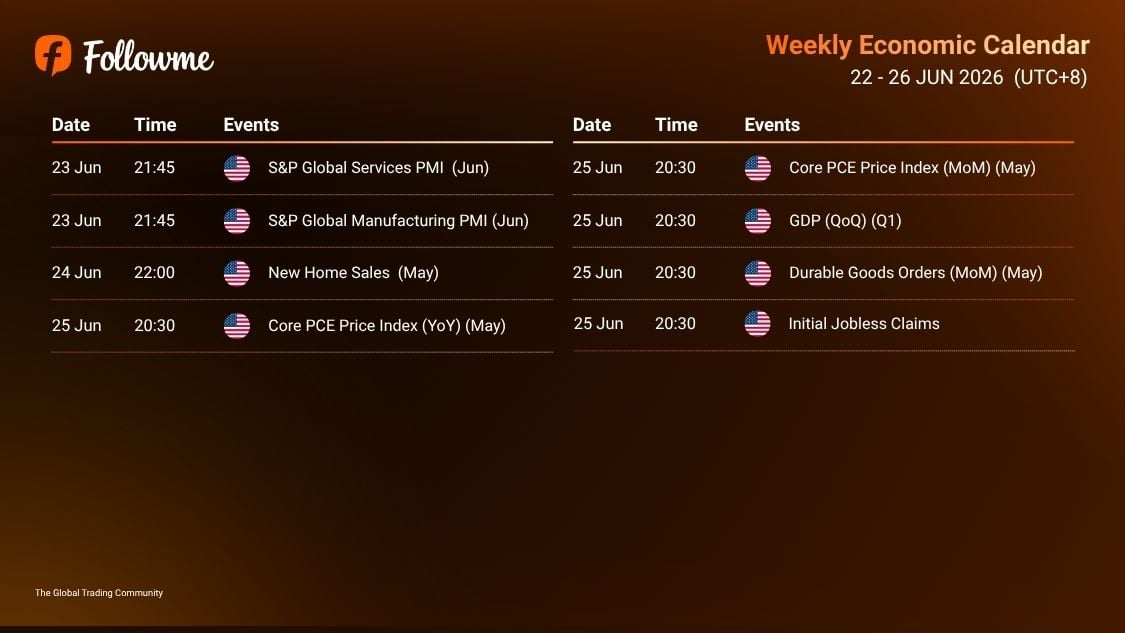
This week’s economic calendar is heavily focused on the U.S. S&P Global Services and Manufacturing PMI, New Home Sales, the Core PCE Price Index, GDP (QoQ), Durable Goods Orders, and U.S. Initial Jobless Claims.
The week opens on Tuesday with both PMI readings, followed by New Home Sales on Wednesday — a relatively quiet build-up compared to what’s coming next. Thursday is where the week’s real volatility lives. Core PCE, GDP, Durable Goods Orders and Initial Jobless Claims all land at 20:30 in the same session, creating one of the most data-dense windows of the month for USD, gold, U.S. indices and broader risk sentiment. Core PCE stands out as the headline release as the Fed’s preferred inflation gauge — any deviation from the 3.30% forecast is likely to set the tone for how markets interpret everything else that drops alongside it.
Key Events This Week
🕐 All times shown are GMT+8
| Date | Time | CCY | Event | Forecast | Previous |
|---|---|---|---|---|---|
| 23/6 | 21:45 | 🇺🇸 USD | S&P Global Services PMI (Jun) | 50.9 | 50.9 |
| 21:45 | 🇺🇸 USD | S&P Global Manufacturing PMI (Jun) | 55.3 | 54.5 | |
| 24/6 | 22:00 | 🇺🇸 USD | New Home Sales (May) | 661K | 663K |
| 25/6 | 20:30 | 🇺🇸 USD | ⭐ Core PCE Price Index (YoY) (May) | 3.30% | 3.20% |
| 20:30 | 🇺🇸 USD | Core PCE Price Index (MoM) (May) | 0.30% | 0.30% | |
| 20:30 | 🇺🇸 USD | ⭐ GDP (QoQ) (Q1) | 2.00% | 0.50% | |
| 20:30 | 🇺🇸 USD | Durable Goods Orders (MoM) (May) | 4.00% | 1.30% | |
| 20:30 | 🇺🇸 USD | Initial Jobless Claims | 220K | 225K |
Macro Analysis
🇺🇸 U.S. S&P Global Services and Manufacturing PMI
S&P Global Services PMI for June is forecast at 50.9, holding flat with the prior reading. Manufacturing PMI is forecast at 55.3, up from 54.5 a number that’s already comfortably in expansion territory and expected to climb further still. These two paint a picture of an economy that’s holding up better than many expected heading into summer. A beat on either, especially Manufacturing, would reinforce the idea that factory activity is genuinely accelerating, which should support USD. If Services slip below 50.9 or Manufacturing fails to build on its recent strength, it may raise questions about whether this expansion has legs, and the Dollar could soften on the back of it.
🇺🇸 U.S. New Home Sales
New Home Sales for May are forecast at 661K, a slight pullback from 663K prior. The move is small enough that it shouldn’t shake markets on its own, but it’s still a useful read on whether elevated mortgage rates are starting to weigh on demand. A number in line with or above forecast would suggest the housing market is stabilizing rather than deteriorating, a mildly USD-supportive signal. A sharper drop would add to the narrative that higher-for-longer rates are finally catching up with the consumer, which could nudge the Dollar lower.
🇺🇸 Core PCE Price Index
This is the number the Fed actually targets, and it’s arguably the most important release of the week. Core PCE (YoY) for May is forecast at 3.30%, ticking up from 3.20% prior, while the monthly figure is expected to hold steady at 0.30%. An annual rate moving in the wrong direction, even by a tenth, is the kind of detail that could complicate any near-term case for rate cuts. A hotter print would likely support USD by reinforcing a more patient Fed. A cooler-than-expected reading, particularly if the monthly figure dips, would give the Dollar bears something concrete to work with heading into the weekend.
🇺🇸 U.S. GDP (QoQ)
The final estimate for Q1 GDP is forecast at 2.00%, a notable upgrade from the 0.50% initial reading. That’s a wide gap, and if the final number lands anywhere close to forecast, it tells a very different growth story than markets were working with earlier this year. A strong upward revision would support USD by suggesting the economy had more underlying momentum than the early data captured. If the revision falls short and growth comes in weaker than 2.00%, it could undercut some of the optimism building around U.S. economic resilience.
🇺🇸 Durable Goods Orders
Durable Goods Orders for May are forecast at 4.00%, a sharp jump from 1.30% prior. That’s a big swing, and durable goods data tends to be volatile month to month, so the headline number alone may not tell the full story, but a beat this size would still be read as a sign that business investment is picking up. A strong print would likely support USD by adding to the broader theme of economic resilience. A miss could dent confidence in the manufacturing and capital expenditure outlook just as PMI data earlier in the week suggested things were improving.
🇺🇸 U.S. Initial Jobless Claims
Claims are forecast at 220K, easing from 225K prior. A move in the right direction, even if modest, supports the idea that the labour market remains stable heading into summer. With this landing on the same day as Core PCE, GDP and Durable Goods, claims won’t be the headline event, but a meaningful surprise in either direction could still add to or dampen whatever reaction the bigger releases generate. A lower print keeps the soft-landing narrative intact; a higher one adds a layer of concern to an already data-heavy session.
Speculative Outlook for USD Traders
This week builds gradually before peaking on Thursday, when four major releases land within the same half hour. In the early part of the week, PMIs on Tuesday and New Home Sales on Wednesday set the tone without doing much to move markets on their own. The real test comes with Core PCE, GDP, Durable Goods and Jobless Claims all hitting at 20:30 on Thursday, creating one of the more data-dense sessions of the month.
🟩 Bullish USD Scenario — Stronger Dollar Case
- Manufacturing PMI Extends Its Gain — A reading above 55.3 would reinforce the view that factory activity is genuinely accelerating, not just stabilizing, and support USD broadly.
- Core PCE (YoY) Beats 3.30% Forecast — A hotter annual print on the Fed’s preferred inflation gauge would make near-term rate cut talk much harder to justify.
- GDP (QoQ) Confirms Strong Upward Revision — A final reading at or above 2.00% would validate the idea that Q1 growth was far more resilient than the initial estimate suggested.
- Durable Goods Orders Beat 4.00% Forecast — A strong headline number would add real weight to the argument that business investment is picking back up.
- Initial Jobless Claims Stay Low — A reading at or below 220K would keep the labour market story clean heading into a heavy data session.
- New Home Sales Hold Steady — A number in line with the 661K forecast would suggest housing demand isn’t cracking under current rate conditions.
🌡 Wild Cards — High Whipsaw Risk
- PCE vs GDP Conflict — If inflation comes hot but the GDP revision disappoints, traders may struggle to decide whether the data is bullish or bearish for USD, and the reaction could swing both ways within minutes.
- Durable Goods Volatility — This series is notoriously choppy, and a number wildly different from the 4.00% forecast in either direction could trigger an outsized reaction that fades just as quickly once the dust settles.
- PMI Divergence — If Services and Manufacturing move in opposite directions on Tuesday, it may complicate the broader narrative about how balanced the U.S. expansion really is.
- GDP Revision Surprise — A final estimate that lands far from both the 0.50% initial read and the 2.00% forecast would force a rapid repricing of how the market views Q1 growth altogether.
- Four-Release Thursday — With Core PCE, GDP, Durable Goods and Claims all dropping at the same time, even data points that align with forecasts could produce unpredictable price action simply due to the sheer volume of information hitting at once.
- New Home Sales Outlier — A sharp deviation from 661K, in a week otherwise dominated by inflation and growth data, could still catch positioning off guard if it shifts the broader housing narrative.
🔴 Bearish USD Scenario — Weaker Dollar Case
- Core PCE (YoY) Falls Short of 3.30% Forecast — A softer print on the Fed’s key inflation gauge would reopen the door to rate cut expectations and weigh on USD.
- GDP (QoQ) Misses 2.00% Forecast — A weaker-than-expected final reading would undercut the resilience narrative and raise fresh doubts about underlying growth momentum.
- Durable Goods Orders Miss Sharply — A reading well below 4.00%, particularly after such a strong forecast, would dent confidence in the business investment outlook.
- Initial Jobless Claims Rise Above Consensus — A print meaningfully above 220K would introduce labour market concerns just as the bigger inflation and growth data is being digested.
- S&P Global PMIs Disappoint — A slip below 50 on Services or a stall in Manufacturing’s recent momentum would suggest the early-summer expansion is losing steam.
- New Home Sales Drop Meaningfully — A sharper than expected decline would add to concerns that elevated rates are finally weighing on consumer housing demand.
If PMIs hold firm, Core PCE ticks higher, GDP confirms a strong upward revision and Durable Goods beats meaningfully, USD has every reason to push higher into the end of the week. If the data disappoints across the board — softer PMIs, a cooler PCE read, a weaker GDP revision and a Durable Goods miss — the Dollar could give ground quickly as the resilience narrative takes a hit all at once. With so much landing in a single session, Thursday has real potential to set the tone for how markets close out the month.
Check out the full calendar here: Followme Economic Calendar Tool
Follow Followme for the newest market updates




免責事項:本記事で述べられている見解は著者の見解のみであり、Followmeの公式見解を反映するものではありません。Followmeは、提供された情報の正確性、完全性、信頼性について一切責任を負いません。また、書面で明示的に記載されている場合を除き、本記事の内容に基づいて行われたいかなる行動についても責任を負いません。

-終わり-